Most businesses believe they have a funnel. Traffic comes in, leads are generated, sales happen. On paper, it looks complete. In reality, what most companies operate is a linear handoff, not a funnel system.
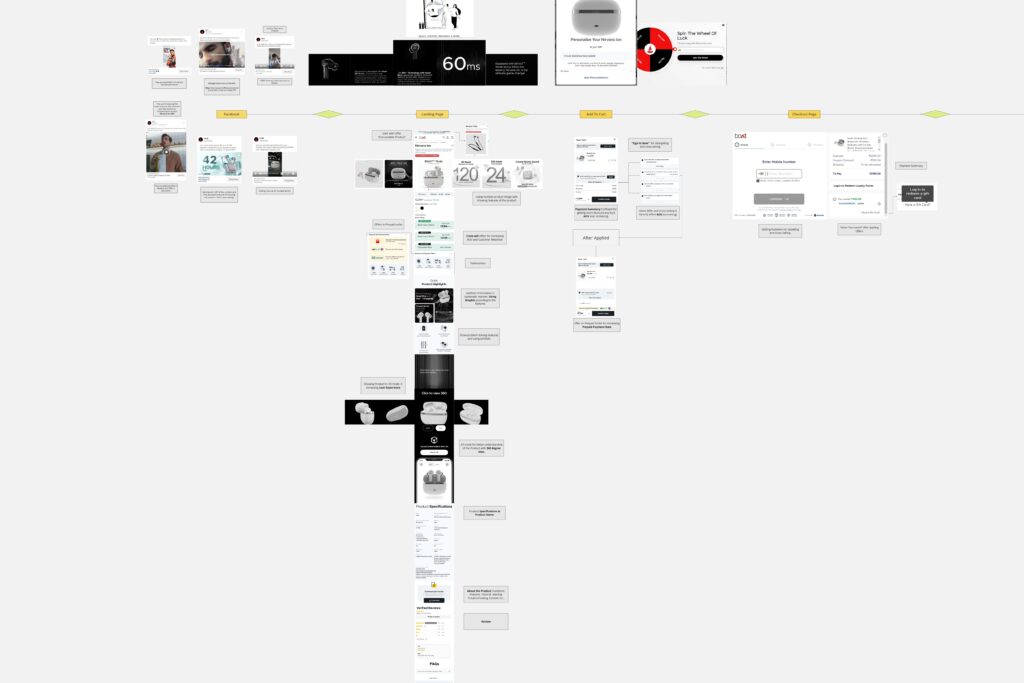
To understand the difference, let us compare a basic funnel commonly used by businesses with a more engineered funnel approach seen in mature D2C brands like BOAT.
The Basic Funnel Most Businesses Use
A typical funnel looks like this. Traffic comes from platforms like Facebook or Google. Users are sent to a landing page or sometimes directly to a social media profile or WhatsApp. From there, interested users either fill a form, send a message, or request a call. A sales call happens. Some convert. Most drop off.
This funnel assumes that interest equals intent. It treats all users the same regardless of awareness level, hesitation, or buying readiness. There is minimal education, weak trust building, and no structured decision journey.
The result is predictable. High traffic but low conversions. Sales teams complain about poor lead quality. Marketing blames sales follow up. Leadership increases ad spend or adds more sales resources hoping volume will compensate for inefficiency.
This is not a funnel problem. It is a process problem.
The BOAT Funnel Is Not Linear. It Is Layered.
BOAT’s funnel works because it is not designed as a straight line from click to checkout. It is designed as a sequence of controlled decisions.
First, traffic is segmented based on intent and context. Different users encounter different messages depending on where they are in their buying journey. Awareness content does not push for immediate purchase. It builds curiosity and credibility.
Next comes structured product education. Instead of assuming users understand the product, the funnel walks them through features, comparisons, use cases, and outcomes. This reduces uncertainty before price is even considered.
Then comes social proof and reassurance. Reviews, testimonials, ratings, and usage cues appear at the right moments, not randomly. Trust is reinforced exactly when the user is evaluating risk.
Only after this does the funnel introduce urgency, offers, or nudges. Discounts are not used as crutches but as accelerators once clarity exists.
Checkout itself is treated as a process, not a page. Steps are optimized to reduce friction, explain why information is needed, and reassure the buyer continuously until payment confirmation.
What looks like multiple pages is actually one engineered conversation.
Why This Funnel Converts Better
The key difference is intent management.
Most funnels push users forward. BOAT’s funnel guides users forward.
Every stage answers a specific question in the buyer’s mind. What is this product. Is it right for me. Can I trust this brand. Is the price justified. Is it safe to pay now.
Because these questions are addressed systematically, drop offs reduce naturally. The funnel does not rely on aggressive retargeting or constant discounts to recover lost users.
This is Business Process Engineering applied to marketing and sales.
Why Copying Pages Will Not Work
Many businesses try to replicate this by copying landing pages, layouts, or creatives. That fails because the strength of the funnel is not design. It is orchestration.
BOAT’s funnel works because messaging, timing, ownership, and systems are aligned. Marketing, product, operations, and technology move together. Data flows cleanly. Decisions are intentional.
Without this alignment, adding more steps only adds more confusion.
What Founders and Leaders Should Learn
The lesson is simple. Funnels are not about pages. They are about processes.
If your funnel depends on sales teams to fix confusion, it is broken. If your funnel relies on discounts to close gaps, it is fragile. If your funnel cannot explain why users drop off, it is blind.
Businesses that scale profitably engineer how users think, not just where they click.
How Dialogent Helps Fix Funnel and Revenue Leaks
At Dialogent Business Solutions, we do not redesign funnels in isolation. We engineer the entire revenue process around them.
We analyze how intent flows from traffic to conversation to decision. We identify where clarity breaks, where trust weakens, and where execution fails. Then we design systems that align marketing, sales, and operations into one disciplined revenue engine.
If your funnel generates activity but not outcomes, the problem is not traffic. It is structure.
If you want to fix revenue leaks, improve conversions, and build a funnel that actually scales, reach out to Dialogent Business Solutions. We help businesses move from fragmented funnels to engineered revenue systems built for long term growth.